
Tyre pressure for truck tyres – correct tyre pressure for safety, economy and longer lifespan
4 September 2026
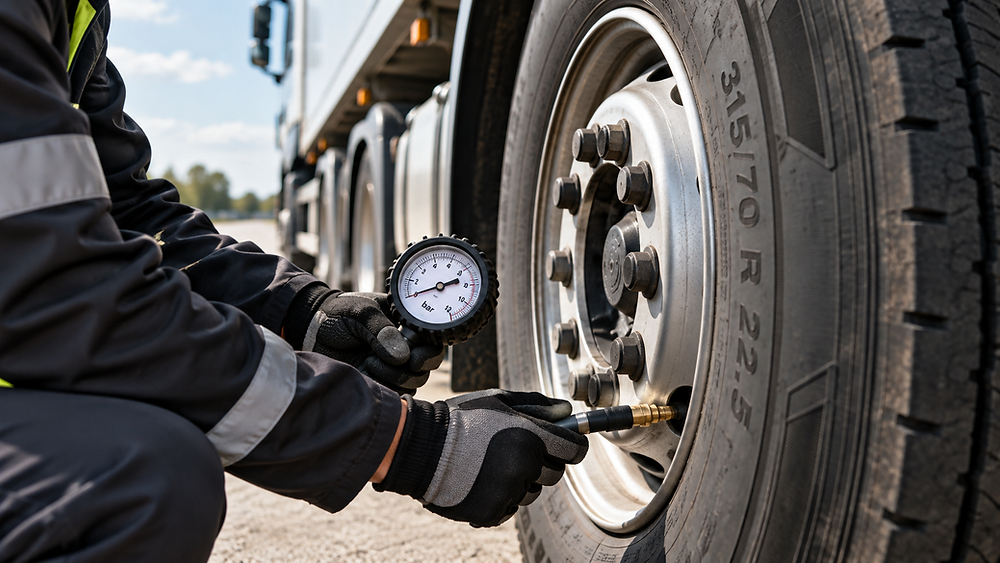
Correct tyre pressure in truck tyres is essential for safety, fuel economy and tyre lifespan. A tyre with incorrect tyre pressure can wear unevenly, generate unnecessary heat and negatively affect both handling and rolling resistance.
For haulage companies and businesses with heavy vehicles, regular tyre pressure checks can therefore be a simple measure that contributes to lower costs and fewer unplanned tyre issues.
But what tyre pressure should a truck tyre actually have? There is no single pressure that is correct for all trucks and tyres. The correct tyre pressure depends, among other things, on tyre size, load, axle position and tyre model.
Here we go through what you need to consider.
What tyre pressure should truck tyres have?
The correct tyre pressure is not determined solely by the fact that the tyre has, for example, the size 315/80R22.5 or 385/65R22.5.
The correct pressure depends, among other things, on:
-
tyre size
-
tyre model and construction
-
the load on the axle
-
whether the tyre is fitted on a steer, drive or trailer axle
-
single or twin fitment
-
the vehicle manufacturer's specifications
-
the tyre manufacturer's load and pressure tables
Therefore, you should not rely on a generally recommended number of bar for all truck tyres. Two trucks with the same tyre size may have different operational conditions and consequently require different tyre pressures.
Where do I find the correct tyre pressure?
First and foremost, refer to the vehicle manufacturer's recommendations and the relevant tyre manufacturer's technical information.
Tyre manufacturers use load and pressure tables showing what tyre pressure is required for the tyre to carry a specific load under specified conditions.
To optimise tyre pressure, you therefore need to know the actual load on each axle. If you are unsure, you should check the specifications for your specific vehicle and tyres, or seek advice from a tyre specialist.
What happens if truck tyres have too low tyre pressure?
Under-inflation means the tyre deflects more as it rolls. This can generate higher heat build-up and increase the stress on the tyre's internal structure.
Too low tyre pressure can contribute to, among other things:
-
increased rolling resistance
-
higher fuel consumption
-
abnormal or uneven wear
-
reduced stability
-
higher temperature in the tyre
-
increased stress on the tyre casing
-
shorter lifespan
On heavy vehicles, this is particularly critical as tyres often operate under high loads and cover long distances.
A minor pressure discrepancy left unchecked over thousands of kilometres can therefore have a major impact on both tyre economy and operational reliability.
What happens if tyre pressure is too high?
More air is not automatically better.
Over-inflation can alter the tyre's contact patch with the road surface and affect both wear patterns and handling characteristics.
Depending on the tyre and application, too high pressure can contribute to, among other things:
-
uneven wear
-
reduced ride comfort
-
altered road grip
-
greater vulnerability to certain types of impacts and damage
The goal is therefore not to achieve as high a tyre pressure as possible, but the correct tyre pressure for the load and the tyre.
Check tyre pressure when tyres are cold
Tyre pressure changes as the tyre warms up.
When a truck is driven, the tyres heat up and the pressure rises. A measurement taken immediately after driving for a longer distance can therefore show a higher reading than the tyre's cold pressure.
For the most consistent and accurate check possible, tyre pressure should normally be checked when the tyres are cold, in accordance with the manufacturer's instructions.
Avoid bleeding air from a hot tyre simply because the pressure is higher than the recommended cold pressure. When the tyre cools down, the pressure will drop again.
Temperature affects tyre pressure
Ambient temperature also affects tyre pressure.
When the temperature drops, the pressure inside the tyre decreases, and when the temperature rises, it increases. This makes regular checks particularly important during significant seasonal temperature shifts, such as during autumn and winter.
A truck that had the correct tyre pressure during a warm period will not necessarily maintain the exact same pressure when temperatures drop sharply.
Ahead of winter, it is therefore wise to check tyre condition, tread depth, winter markings and tyre pressure.
Feel free to read our guide on vinterdäck till lastbil for more information on what to consider ahead of the winter season.
Tyre pressure on steer, drive and trailer tyres
The axle position of the tyre also plays a role.
Steer tyres
Steer tyres are crucial for the truck's steering response and stability. Incorrect tyre pressure can also contribute to uneven wear patterns.
Drive tyres
Drive tyres transmit the engine's power to the road surface and often operate under high loads. The right combination of tyre, load and tyre pressure is therefore vital for both grip and service life.
Trailer tyres
On trailers and semi-trailers, the load can be heavy and vary considerably depending on the freight. Here too, tyre pressure must be matched to the tyre's specification and the load.
It is therefore not advisable to automatically apply the same pressure across all axles without checking the specific requirements for each individual tyre and position.
Tyre size matters – but does not tell the whole story
Common sizes such as:
can be found on different types of heavy vehicles and axle positions.
The size is important when sourcing the right tyre, but it is not enough on its own to determine the correct tyre pressure to use.
You also need to take into account the tyre's load capacity, actual axle load, fitment and manufacturer specifications.
If you want to know more about what the numbers mean, read our guide on vanliga dimensioner på lastbilsdäck.
Uneven wear can reveal underlying issues
When checking tyre pressure, it is also an ideal opportunity to inspect the tyres.
Look for:
-
uneven wear across the tread
-
abnormal wear on the tyre shoulders
-
cuts
-
cracks
-
bulges or deformations
-
foreign objects trapped in the tread
-
distinct differences in wear between tyres on the same axle
Uneven wear does not necessarily stem solely from incorrect tyre pressure, however. Wheel alignment, axle geometry, load distribution, tyre selection and operating conditions can also have an effect. If a tyre starts wearing abnormally, the root cause should be investigated rather than simply adjusting the tyre pressure.
How often should you check tyre pressure on a truck?
For heavy vehicles, regular checks are an essential part of tyre maintenance.
How often pressure needs to be checked depends on the operation and the vehicle, but establishing a set routine where tyre pressure is checked regularly – and always at the slightest suspicion of pressure loss – is good practice.
Additional checks are advisable:
-
during major temperature changes
-
before long-distance journeys
-
when load or vehicle application changes
-
if a tyre starts to show abnormal wear
-
after work or driving where the tyre may have sustained damage
Even if the vehicle is fitted with a Tyre Pressure Monitoring System (TPMS), conducting visual inspections remains equally important.
Correct tyre pressure can contribute to longer lifespan
Truck tyres represent a substantial expenditure for many hauliers. Running tyres at the correct tyre pressure is key to maximising their operational life.
However, tyre pressure is only one part of the overall picture.
Tyre lifespan is also influenced by, among other things:
-
wheel alignment
-
load
-
driving style
-
road surface conditions
-
axle position
-
choice of tyre
-
regular inspections and maintenance
Read more in our guide Så förlänger du livslängden på lastbilsdäck.
Frequently asked questions about truck tyre pressure
How many bar should there be in a truck tyre?
There is no universal bar figure that applies to all truck tyres. Correct tyre pressure depends, among other factors, on the tyre, size, load, axle position and fitment. Always refer to the vehicle and tyre manufacturers' specifications.
Should you measure tyre pressure when the tyre is hot or cold?
Tyre pressure should normally be checked when tyres are cold. During operation, tyres heat up and the air pressure increases.
Can low tyre pressure increase fuel consumption?
Yes, low tyre pressure increases rolling resistance, which can lead to higher fuel consumption. It also accelerates heat build-up and tyre wear.
Can you run the same tyre pressure in all truck tyres?
Not necessarily. Loads, tyre dimensions, tyre models, axle positions and fitments can all vary. Always verify the correct pressure for each specific application.
Does cold weather affect tyre pressure?
Yes. Tyre pressure changes with temperature and drops as the temperature falls. This makes it especially important to check tyre pressure during seasonal and temperature changes.
Do you need help with truck tyres?
At FHDäck Frösshammar you will find truck tyres for steer, drive and trailer axles in several common sizes.
We assist companies and hauliers in finding the right tyres based on vehicle type, size, axle position and intended application.
Can't find the right tyres on our website or unsure which option suits your vehicle best? Contact us and we will be happy to help.
Telephone: 019-26 07 00
Email: info@frosshammar.se
Se hela vårt sortiment av lastbilsdäck här.
Lastbil på landsväg – vanliga dimensioner på lastbilsdäck
Lastbil kör på landsväg genom gröna fält – illustration av däckslitage och däcklivslängd.
Lastbil kör på vinterväg genom snötäckt landskap – illustrerar guide om lastbilsdäck 2026.
Call us on +46 19 26 07 00 or send us a message and we will help you.
Contact us